Where Is Wagyu Beef Cut From
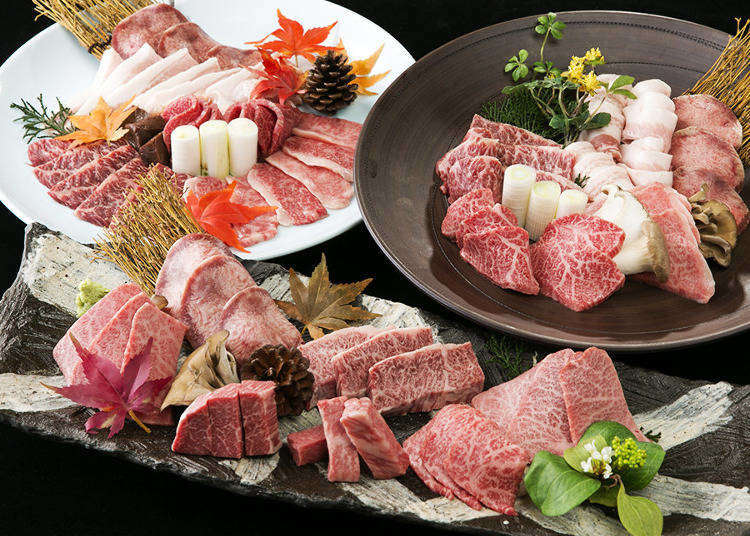
Japanese Wagyu Beefiness: Essential Guide to Japan's Gourmet Steak
Appointment published: 5 June 2019
Terminal updated: 27 November 2020
Every gourmet knows Japanese wagyu beef, the famous cut that fetches prices three times higher than the European meat commonly available in Japan*.
Wagyu is often called "the almost expensive beefiness in the world," with brands such as Kobe beefiness and Matsusaka beef being praised as cultivating the "art of meat," raising every beast advisedly and under rigorous management, then enjoying the beef delicacy is on the must-do list of many a visitor to Japan.
But what is delicious Japanese beefiness and which things should y'all proceed in listen when picking a eating house and ordering? And is Japanese wagyu beef just another proper name for Kobe beefiness?
We have compiled a guide to answer your questions and help you navigate the vast globe of wagyu!
(*As of June 2017)
- Tabular array of Contents
-
- What is Japanese Wagyu Beef?
- Japanese wagyu beefiness breeds
- Near Wagyu Brands and Grades
- Japanese Beef: The Most Popular Wagyu Cuts
- Tajima Cattle: Root of all Wagyu
- Wagyu Tips and Tricks: Reading the Menu
- Yakiniku Barbecue: Tasting Different Cuts
- How much is wagyu in Japan? Wagyu for Every Upkeep
- Crave Japanese wagyu beef? Book a table now!
What is Japanese Wagyu Beef?
"Wagyu" ways "Japanese beef." It refers to four unique breeds of purebred cattle: Kuroge (Japanese Black), Akage (Japanese Brown), Nippon Tankaku (Japanese Shorthorn), and Mukaku (Japanese Polled). This nomenclature was established in 1944.
For those four wagyu breeds, cantankerous-breeding with other cattle varieties is prohibited. These four strains emerged past cantankerous-breeding with cattle generally from Europe in the late 19th and early 20th centuries. Their common ancestor? Tajima cattle.
More often than not, Japan-raised cows are referred to every bit "domestic cattle" in Japan. This includes wagyu but likewise other varieties, such as Angus, Jersey, or Holstein, that were raised in the country as well. Even imported cattle can exist counted equally domestic if the feeding period in Japan is longer than the feeding flow overseas.
Japanese wagyu beef breeds
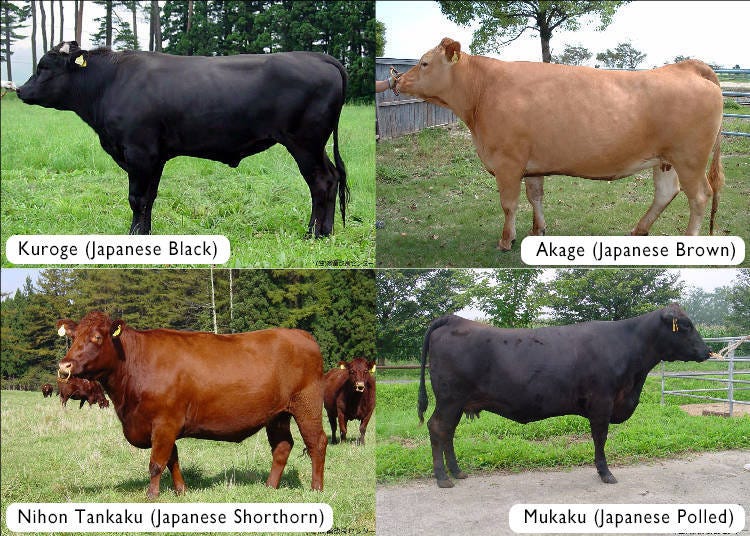
Wagyu Beefiness Cattle: Only 4 native breeds
- Japanese Black
- (Kuroge)
- Japanese Brownish
- (Akage)
- Japanese Shorthorn
- (Japan Tankaku)
- Japanese Polled
- (Japan Mukaku)
Domestic Japan Beef: All cattle bred and raised in Japan, no matter the breed
- Wagyu
- (Wagyu)
- Holstein
- (Horusutain)
- Jersey
- (Jājī)
- Angus, etc.
- (Angasu)
Virtually Wagyu Brands and Grades
A lot of Japanese restaurants offer Japanese wagyu beefiness and barbecue dishes – so how exercise you know the quality of the beef? The primary criteria to be on the lookout man for are brand and grade. Let's take a expect at both.
Brand
The brand of the beefiness indicates the areas where the cattle come from. The three virtually famous Japanese wagyu beef areas are Kobe beef from Hyogo Prefecture, Matsusaka beef from Mie Prefecture, and Omi beef from Shiga Prefecture.
In total, Nihon boasts over 150 beef brands from the Japanese black, then if yous see a restaurant offer wagyu, cheque (or ask for) the brand or production surface area.
Grade
The other important indicator of wagyu quality is the grade. You'll often run into grades such as "A5" written on a eating house's signboard or carte du jour. This classification refers to a universal system, grades awarded by a member of the Nihon Meat Grading Association.
The "Yield Grade" is marked by letters from A to C, indicating how much high-quality meat ane cow offers, not counting parts such as pare and internal organs, of course. The highest yield form that can be attained is A.
A number between 1 and five then follows this letter – this is the "Quality Grade." Four criteria determine how high the quality grade is: marbling, meat color and brightness, firmness and texture of meat, and color, luster, and quality of fat.
As such, A5 is the highest grade that Japanese wagyu beef can get and, also, the most expensive. Once you know what the wagyu form system is all about, it will be a tremendous help in making a conclusion when choosing a restaurant or what to lodge.
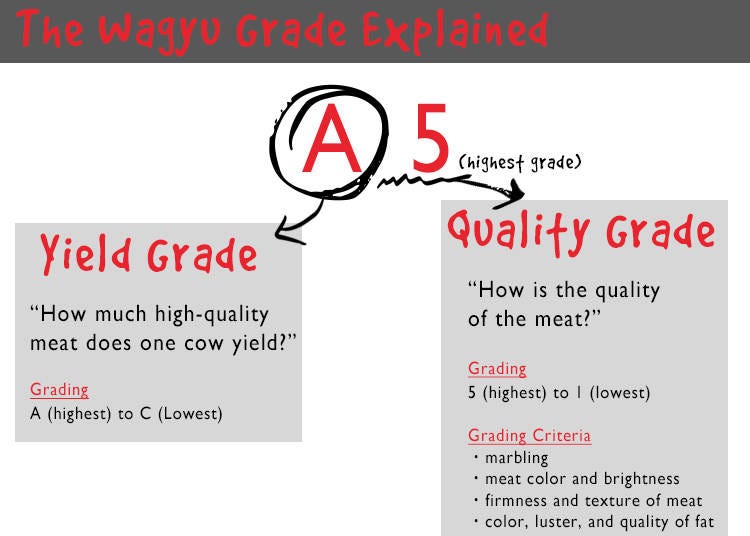
・ A to C: The Yield Course, with A beingness the highest.
・ ane to 5: The Quality Course, determined by four criteria, with v being the highest.
Japanese Beef: The Nearly Popular Wagyu Cuts
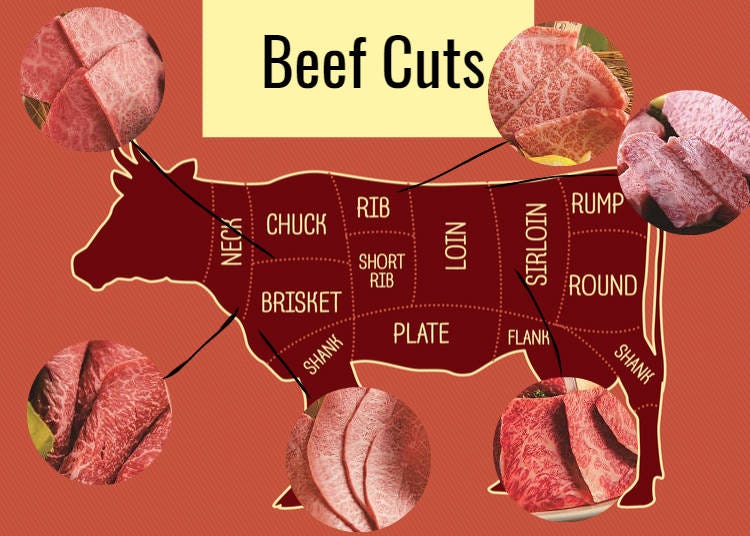
Just like any beef, wagyu has all sorts of different cuts with their ain unique flavor and olfactory property. The most sought-afterwards is sirloin meat (サーロイン / sāroin), by and large used to brand wagyu steak or sukiyaki.
The meat around the loin boasts a fine marbling and thus makes for the best cuts to savor the feature sense of taste of Japanese wagyu beef. Another smashing pick is the rib roast (リブロース, riburōsu), offering a prissy residuum between marbled and lean meat and this cut is most oft used for shabu-shabu, Japanese fondue.
Other prime cuts of include chuck flap (ハネシタ, haneshita), making for a roast of the highest quality, as well every bit bottom flap (カイノミ, kainomi), a small, delicious role of the rib area.
A lot of Japanese-style barbecue restaurants, called yakiniku, serve such rare cuts that every Japanese cow but has one to offer of. Below is a list of popular cuts among Japanese gourmets, to make your choice even easier:
1) Wagyu Sirloin (サーロイン / sāroin)
・ Description: regarded as the best of beef cuts. From the loin.
・ Appearance: a fine, mesh-like marbling.
・ Taste: a rich, total-bodied flavor that spreads throughout the entire mouth.
・ Endeavor equally: steak, shabu-shabu, sukiyaki.
2) Wagyu Skirt Steak (ハラミ / harami)
・ Clarification: the diaphragm, a cut from the plate. Sometimes also called "sagari" (サガリ).
・ Appearance: deep red meat that is really offal.
・ Taste: despite being offal, skirt meat tastes like actual red meat.
・ Endeavor every bit: barbecued with a rich sauce.
three) Wagyu Offal (ホルモン / horumon)
・ Description: usually refers to different kinds of offal. Sometimes used for the big intestine (シマチョウ / shimachō)
・ Appearance: white and rather fatty
・ Taste: firm to the bite, fatty, and with a rich sense of taste.
・ Attempt as: thoroughly barbecued until aureate-brown, all-time enjoyed with a rich sauce.
4) Wagyu Ribs (カルビ / karubi or kalbi)
・ Description: "kalbi" is the Korean word for rib and generally stands for beefiness ribs.
・ Appearance: lean meat with a very fine, mesh-similar marbling.
・ Taste: the marbling makes for a deep flavor.
・ Try as: plain or with a hint of salt.
five) Wagyu Brisket (肩バラ / katabara)
・ Description: a cutting from the chest or lower chest part.
・ Advent: layers of lean meat and fat, a rather tough cutting.
・ Taste: tender afterward cooking, with a compactness to the bite close to ribs.
・ Try every bit: boiled in stews, basis as hamburger
six) Wagyu Natural language (タン / tan)
・ Description: beefiness tongue.
・ Advent: tin exist cut into slices of dozens of centimeters long. Often thinly sliced.
・ Sense of taste: a unique, caused gustatory modality with an equally unique texture.
・ Try as: briefly barbecued, tastes best with salt and lemon juice.
7) Wagyu Chuck Center (肩ロース / katarōsu)
・ Clarification: a roast from the meat betwixt the shoulder and back.
・ Appearance: fat towards the head, with a fine marbling.
・ Gustatory modality: an fantabulous balance of lean meat and fatty.
・ Try as: sukiyaki
8) Wagyu Ribeye, Spencer Roll (リブロース / riburōsu)
・ Description: from effectually the back and the ribs. One of the best cuts of meat, along with sirloin.
・ Appearance: great balance between lean meat and fatty, beautiful marbling.
・ Taste: a rich umami flavor of fantabulous quality.
・ Endeavor every bit: steak, sukiyaki, shabu-shabu.
Tajima Cattle: Root of all Wagyu
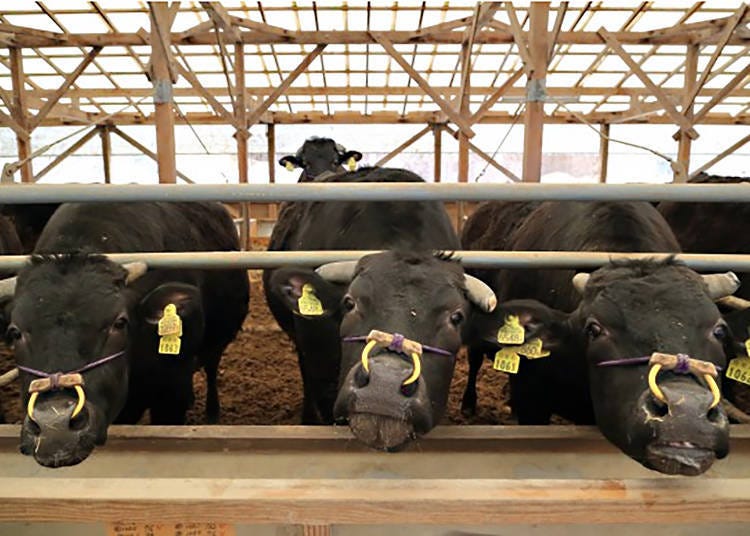
At barbecue specialty restaurants and steakhouses, you'll often see the discussion "Kuroge," Japanese Black on both menus and signboards. Among the four breeds, Japanese Blackness makes upwardly the vast majority of wagyu, with a bulk of a whopping 95%.
The most famous brands and areas, including Yonezawa, Miyazaki, and Sendai, besides every bit the iii big wagyu brands of Kobe, Matsuzaka, and Omi are all Japanese Black.
As mentioned before, the mutual antecedent of the four wagyu strains is Tajima wagyu cattle, used for farming and agriculture since aboriginal times. The cross-breeding with European cattle made the meat of the Tajima cattle incredibly delicious. Information technology is rich in "proficient fat," such equally Omega three and 6 fatty acids, as well as monounsaturated fatty acids.
That's also the reason for the wonderfully smooth mouthfeel of wagyu, a characteristic that made it famous all around the globe. Almost 100% of all Japanese Black beef in Japan can exist traced back to Tajima cattle.
Wagyu Tips and Tricks: Reading the Menu
Especially yakiniku (Japanese barbecue) restaurants avowal menus with a large variety of cuts and dishes. Instead of "kalbi," the Japanese give-and-take for ribs, yous'll often see things like 上カルビ, pronounced jō-kalbi, or 上ロース (jō-rōsu).
The 上 graphic symbol means "up" or "above" and by and large indicates that the meat is fattier than usual and of a slightly higher quality. Sharing this meaning is another often-used expression: 特選, read as "tokusen," and meaning "special choice."
Other characters y'all volition come up across in front end of dish or cut names are 塩 (shio), meaning salt, and ネギ (negi), meaning green onion. This means that the meat has been marinated in sauce or comes with said toppings and tin can be understood as a recommendation by the restaurant – "We'd similar yous to attempt it with this." The rule of thumb is to only ask the staff if you lot are not sure or take a question!
Yakiniku Barbecue: Tasting Unlike Cuts
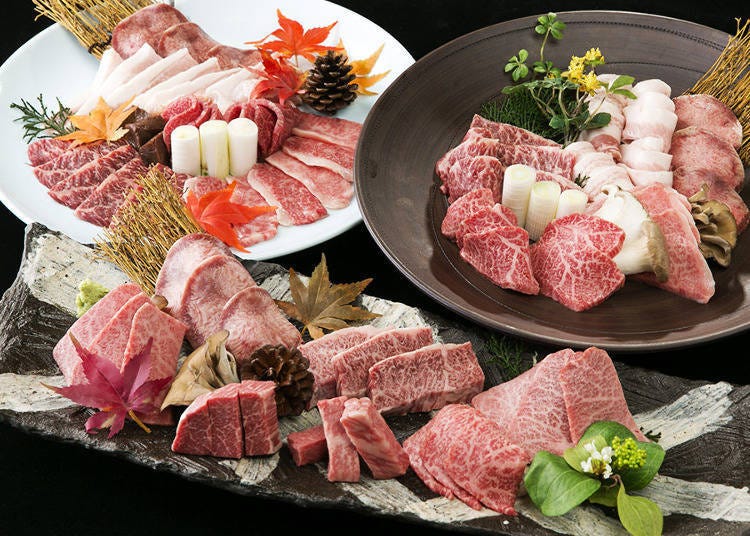
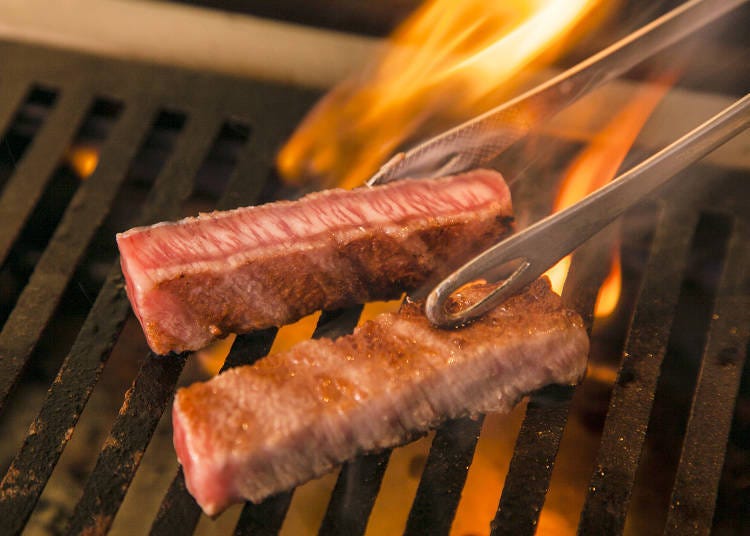
Japanese Blackness wagyu is used in many dishes, including classics such as steak and sukiyaki. One of the best ways to savor and attempt unique cuts is yakiniku, a Japanese charcoal-broil.
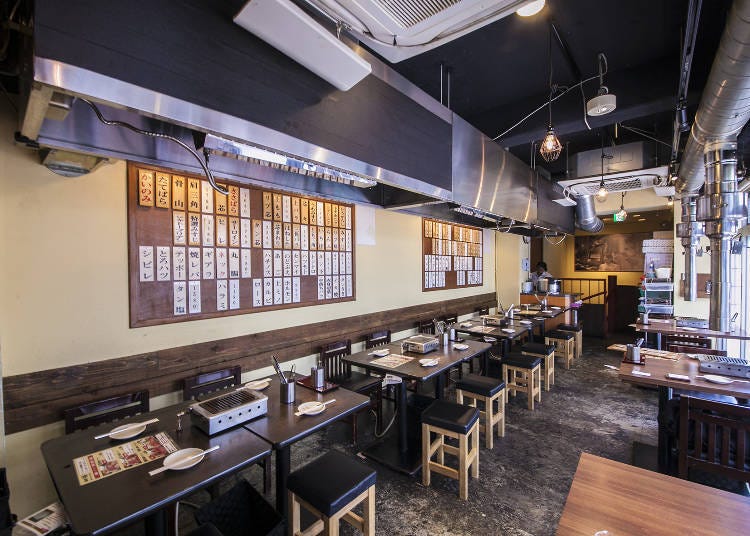
An first-class place to exercise just that is a restaurant chosen Boya, located near Ueno'south Okachimachi Station. Boya offers a rich variety of choice cuts for reasonable prices, including sirloin and ribeye, but also rare delicacies such every bit chuck flap and inner shoulder. The eating house's secret is to purchase one entire cow from a choice of famous brands, including Yonezawa, Sendai, or Hitachi – always the 1 with the highest toll performance at the time of purchase.
Nosotros highly recommend ordering the array of cuts the beginning time you visit, which volition allow you to try sirloin, ribs, chuck flap, and other delicious cuts. Information technology'due south a beautiful balance of marbled and lean meat, bringing out the characteristics and unique flavour of Japanese Blackness wagyu but perfectly. Boya boasts a diversity of such assortments, and another instance is "Boya Ittomori" (4,980 yen, four cuts for 2-3 people), offering meat that is more than on the fat side, or "Marutokumori" (3,980 yen, four cuts for 2-3 people), to proper name a few.
How much is wagyu in Japan? Wagyu for Every Budget
About people expect to pay a ridiculously high price if they actually ordered Kobe beefiness, or even Matsusaka or Omi beef at a restaurant in Tokyo. However, not all places serving wagyu are upscale and expensive.
Next to these three famous brands, Nihon boasts a large diversity of wagyu producers! Some might non exist equally famous or internationally known but taste cracking nonetheless and are far friendlier for the wallet, fitting in basically every upkeep.
Still – the need for wagyu is rising all effectually the world and as every single cow is carefully raised by hand, it'south difficult for the production to keep upward. If you desire to get to know the gourmet delights of wagyu for affordable prices, at present is the best time!
-
Boya (Ueno Rokuchome Location)
房家 上野六丁目店
- Accost 6-half dozen-6 Ueno, Taitō-ku, Tōkyō-to 110-0005
- Nearest Station Ochanomizu Station, iv minutes on pes
Hours: 11:00 a.1000. – 3:00 p.m., 5:00 p.g. – 11:30 p.one thousand.
Saturdays, Sundays, and national holidays: eleven:00 a.m. – xi:30 p.m.
Closed: always open
Require Japanese wagyu beef? Book a table now!
We also recommend these restaurants in add-on to those above. Save fourth dimension and hassle - volume your tabular array online today!
*This data is from the time of this article's publication.
*Prices and options mentioned are subject field to change.
*Unless stated otherwise, all prices include taxation.
Source: https://livejapan.com/en/article-a0001254/

Post a Comment for "Where Is Wagyu Beef Cut From"