After You Die Brain Knows Youre Dead
Life — after life: Does consciousness continue after our brain dies?
How can people brought back from death after cardiac arrest report having experienced lucid and vivid memories and recollections without a functioning brain? The study of near-death experiences is challenging the idea our consciousness fades to blackness when our body expires

He could see a nurse and doc, a bald, "chunky fella" dressed in blue infirmary scrubs. He watched as they frantically worked on his body, which was remarkable, considering he was, essentially, dead.
The man had suffered a cardiac arrest. Normally there is no measurable, meaningful brain activity after the middle stops beating. Within two to 20 seconds the brain "flatlines."
But the man would later on tell researchers that he could see an unfamiliar woman beckoning from a corner up in the ceiling. "I can't get up there," he remembered thinking to himself, and then the next second, "I was up at that place, looking downwardly at me."
He said he saw his blood pressure level being taken, and a doctor putting something down his throat. He saw a nurse pumping on his chest. He accurately and vividly described the people, sounds and events of his "resurrection."

Dr. Sam Parnia estimates the human experienced conscious sensation for three to five minutes in the absenteeism of detectable brain activity, a time, he has said, "when no human feel should exist happening whatsoever."
The case was function of a widely reported study Parnia published in 2014 called Aware — the awareness during resuscitation trial, the globe's largest written report of what happens to the human being mind and consciousness in the early on menstruum of death.
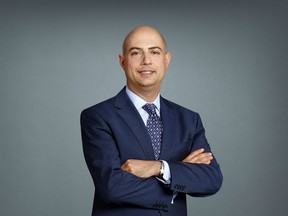
Parnia, at present a disquisitional care and resuscitation specialist at New York'due south NYU Langone Medical Center, believes human being consciousness may proceed after our eye stops beating for some undetermined flow of time.
Evidence from Aware and other studies, he says, raises the possibility that the listen or consciousness — the psyche, the "self," the affair that "makes me Sam" and that makes us uniquely who we are — may not originate in the encephalon and may be a separate, undiscovered scientific entity, similar in nature to the electromagnetic waves that can carry sound and pictures. Modern science simply lacks the tools to testify information technology. When we dice, that entity nosotros call consciousness or the self doesn't necessarily go "immediately annihilated," Parnia believes.
Parnia isn't a religious man. He insists he isn't after proof of the being of an afterlife, or a supernatural time to come. Rather, he and others are trying to discover meliorate ways to save the brain and avoid horrific "disorders of consciousness" like Terri Schiavo, the Florida woman who entered a permanent vegetative land after her brain was starved of oxygen after a cardiac arrest. But Parnia is also out to exam the accuracy of seemingly fantastical claims of near-death experiencers using an objective, scientific approach.
He's now conducting Enlightened II, and would welcome Canadian collaborators.
I was up there, looking downwardly at me
His goal is to study i,500 people in cardiac arrest. When a "lawmaking" is called, participating researchers volition be alerted and dispatched to resuscitation rooms carrying backpacks consisting of portable encephalon oxygen monitoring devices. The plan is to measure out, 2d by second, the oxygen levels inside the brain. At that place will likewise be a portable EEG to measure whether the encephalon is functioning. Also, patients will be fitted with wireless headphones, through which random words and sounds (which demand to remain hugger-mugger until the study is over) will exist transmitted via a tablet. Images will also be beamed upwards every bit people undergo CPR. Parnia doesn't expect anyone to open their eyes. No one ever does in cardiac abort.
"We can and then wait at survivors and run into if they tin retrieve any of these stimuli, and when they were able to receive information, and how that relates to their brain resuscitation quality," Parnia announced at a recent meeting of the European Resuscitation Council.
Ultimately the goal is to endeavour to better understand how to bring dorsum a whole person, not a husk of one, with an intact brain and heed, by developing a kind of gold standard brain oxygen level that doctors should target during cardiac arrest and CPR in order to optimize survival without brain impairment.
But a tidy flip side, Parnia says, is that "we can also study what happens to human being listen and consciousness subsequently people become beyond the threshold of expiry."
In other words, how does the mind chronicle to the brain? "Can consciousness or the cocky go along to work and exist when we die?"
—
Throughout millennia people take tried bizarre means to revive the dead. In the early ages, around 500 Advertising, people realized lifeless bodies are too cold bodies, as Parnia has described in his talks, so they covered the newly dead in warm ashes or burning brute feces, believing heat would restore life. Later came the flagellation method, the idea that the deceased could somehow exist whipped into breathing once more. In xvithursdaycentury Europe, rescuers used fireplace bellows to try to push air into the lungs of corpses.
In the 1900s and early on twentythcentury, and through the Second World War, we learned how to do mouth-to-oral fissure and chest compressions, "and everything changed," Parnia said in an interview.
Today, advances in resuscitation medicine mean we tin opposite decease in people who have been without a pulse for hours. London Free Press journalist Jane Simms last year chronicled the story of Ashlyn Krell who died but was brought back to life after her automobile flipped on Canada's busiest highway, trapping her in a structure hole filled with water ice-common cold water for 27 minutes.
More people are beingness successfully revived afterward "crashing" in a hospital, and Parnia believes even more lives could be saved, more people hauled dorsum across that threshold of expiry, if more than hospitals implemented more than advanced techniques — chilling bodies to protect the brain, or using automated mechanical devices to deliver breast compressions beyond what any man could exercise.
For no matter why we die, Parnia has said — a astringent infection, ridden with cancer, "hitting by a lorry and haemorrhaging" — most ultimately die of cardiac arrest. Blood pressure level drops, the heart isn't able to pump enough blood to supply the body, the heart somewhen stops, respiration stops, electrical activity in the brain ceases and the brain flatlines. Shine a light on the pupils and if they're fixed and dilated, it means the brain stem has stopped functioning.
Parnia attended cardiac arrests when he was in medical schoolhouse 23 years ago. Commonly he didn't know the people; they weren't patients of his. By the time he arrived, they were essentially corpses. Simply towards the finish of his training, he met a patient — "a sweet, lovely man" who unexpectedly went into a cardiac arrest 30 minutes afterward Parnia interviewed him. "It was very different and at present I had personal bail with this human being and he was essentially a lifeless, emotionless trunk," Parnia said.
He remembers seeing him going into a flat-line state, and people frantically trying for an hour to resuscitate the human. He remembers thinking to himself, "What happened to this person's heed and consciousness, this sweetness man that I was talking to just a half an hour agone? Is he witting? Is he able to meet usa, hear united states? When did he lose it, if he did lose his consciousness?" To Parnia, it was all very blurred.
As he stood and watched, he thought: what's been done on this, scientifically?
—
"Transcendental mystical or spiritual experiences close to decease have been described for millennia," Parnia wrote in 2017 in QJM: An International Periodical of Medicine. Plato's Republic told the story of the Greek warrior Er, who died in battle but was brought back and tells a tale of the afterlife. Dutch painter Hieronymus Bosch'southward xvthcentury painting "Ascent of the Blessed" depicts a tunnel of light, with souls ascending into a heavenly place. Just it was after the birth of modern intensive care medicine 40 years ago that the term "most-death experience" came to being. Philosopher and psychiatrist Raymond Moody, whose 1975 book, "Life After Life," detailed the experiences of more than 100 in one case dead — people who experienced "clinical" expiry but were revived — coined it. The book sold more than than xiii million copies.
The stories of "experiencers" share strikingly like features: a sensation of feeling peaceful and joyous and an absence of pain; a warm, welcoming light that draws people, sometimes through a tunnel; beingness greeted by apparitions of deceased relatives, or a "being of light," a panoramic review of central moments of ane's life.
The most widely used tool to quantify near-expiry experiences is called the Greyson NDE Scale. Published in 1983 past American psychiatrist Bruce Greyson, the scale is based on his interviews with 74 people, and scores responses to 16 questions, such as, "Did you run across, or feel surrounded past, a bright low-cal?" "Did you seem to enter some other unearthly world?" A score of seven or higher qualifies the experience every bit an NDE.
Studies have found that six to 23 per cent of cardiac-arrest survivors report lucid memories that fit with a near-death experience.
Parnia dislikes the term. He prefers "actual decease experience," and says NDE'south, for the sake of standardized scientific research, should be limited to those that correspond to an actual physiological land that approximates expiry.
And nothing comes equally shut to understanding the bodily experience of death as cardiac arrest.
—
Parnia was taught in medical school that consciousness is undeniably a by-product of the brain, "that it's probably some sort of epiphenomenon that arises from synaptic action," meaning the communication between neurons. Numerous studies show a correlation between the activity of the heed and changes in the encephalon. Slide someone within a functional MRI and ask him or her to think nigh something happy or sorry. Synaptic changes in oxygen or glucose levels in particular parts of the encephalon lite upwards. "The problem with all those studies are that none of them are causative — none of them show you lot how encephalon cells could possibly generate a thought, which is the primal problem of consciousness," Parnia says.
"If you expect down a microscope at a brain cell, and I said to you, this brain prison cell is now thinking, you lot'd say that'south crazy, it's a brain cell." Brain cells produce proteins that generate changes in sodium, which generates electricity. "That'southward not a idea," Parnia says.
"And if I said, well, somehow, if I connect a hundred or a 1000 or a million of these cells together, it just leads to this magical miracle of thought. There's no mechanism to account for why that should occur. Why would my encephalon cells, millions of them continued together, of a sudden feel guilty, or take a sentiment of guilt, similar if I were to throw a brick in my neighbour'southward window, or be rude to somebody or practise something immoral?"
The moment the heart stops, the brain shuts downwards from a functional perspective, he said. "Yet, paradoxically, what we started to run across is that millions of people accept now been resuscitated, and many of them have reported these very lucid, well-structured idea processes." They're able to form memories, draw conversations and what people were wearing. "Except that their brain has close down and they've gone through death. Which is completely a paradox, it should not happen. If your listen is simply a by-product of your encephalon, if your brain has shut downward, there should be no consciousness."
Yet, paradoxically, what we started to see is that millions of people accept now been resuscitated, and many of them have reported these very lucid, well-structured idea processes
The phenomenon has been described worldwide, from Japan, India, the Middle East and the Americas. They're remarkably consequent across cultures and religions, and have been reported past children as young every bit preschoolers. Parnia once interviewed a three-year-former male child who survived a cardiac arrest after an epileptic seizure. "When I died, I saw a bright lamp," the boy told Parnia during a play session. "Grandma came to encounter me and said I was going to be okay." Other children have described the "being of lite" not every bit God, or Jesus, but Santa Claus. Toddlers aren't exposed to religious doctrine, says Dr. Elaine Drysdale, a clinical professor in the department of psychiatry at the University of British Columbia. Nevertheless they study almost-decease experiences similar to older children and adults.
Parnia's detractors have accused him of "canis familiaris whistling to theists." The notion of a soul or mind existing separate from the body is scientific flapdoodle, they say. Renowned Western University neuroscientist Adrian Owen, who has devoted much of his career searching for signs of consciousness in "vegetative" patients, says the brain is the organ that produces consciousness, full stop. "If you take that organ abroad or impale that organ or that organ dies, you cannot be conscious." While there is no identified conscious center of the encephalon — nothing yous can point to and say, 'there, that'southward where information technology all happens" — Owen was part of an international squad that recently identified ii particularly distinct patterns of complex encephalon activity that can differentiate a conscious encephalon from an unconscious one.
He doesn't believe patients who report near-expiry experiences go to a country where there's no detectable brain response whatsoever. If that were truthful they would be classified as brain expressionless, "and I know of no case in the literature of a brain expressionless patient coming dorsum." Owen's not saying they're not well-nigh dead. But the brain has an astonishing vasculature. Unless a person dies of massive trauma that knocks out all encephalon function immediately, similar going through the windshield of a auto, parts of the brain will continue to get oxygen for some time after the eye stops, Owen says.
Memories or sensations of a seemingly disembodied consciousness could too be happening before the brain shuts downwardly, or subsequently centre and brain office start coming dorsum online. NDE denier and Australian anesthesiologist K. Grand. Woerlee has argued compressions during CPR itself can push button claret around the body and through the brain in sufficient enough amounts to sustain some class of consciousness, and that these people "are most definitely not 'flatlined.' "
In fact, McGill Academy doctors reported final twelvemonth the instance of a 38-year-one-time man who appeared to regain consciousness several times during CPR. The human was defibrillated half-dozen times. Throughout the ordeal he fabricated "purposeful movements to button CPR providers abroad" and verbalized with each jolt of the defibrillator, Dr. Roger Gray reported in the journal Canadian Family unit Doctor. When signs of consciousness were recognized, CPR was immediately halted, and his pulse checked. At that place was no palpable pulse. Restraints were applied, CPR resumed and his centre resumed beating again 17 minutes later he initially went into cardiac abort.
When interviewed iii months later, he recalled experiencing discomfort in his chest and neck, but no pain. Although he made a consummate recovery, the situation was distressing for his resuscitators. None "had e'er experienced a patient regaining consciousness with CPR, nor were they aware that it was possible."
Jimo Borjigin is an associate professor at the Academy of Michigan Medical School. In experiments in rats, Borjigin and her colleagues discovered that the rodents experienced a huge surge in the secretion of brain chemicals within the commencement 30 seconds afterward the heart stops. Their dying brains seemed to get highly angry. "Serotonin in item was very high," she says. "Nosotros know that the serotonin is associated with hallucinations and other mental functions."
Yes, the overall level of electric activity of the brain was lower, Borjigin says. "But the function that is at least partly responsible for witting information processing is actually increased tremendously in the dying brain," she says— for 30 seconds at least.
More astonishing, researchers at Western University reported ii years ago the case of a patient who was taken off life support who continued to show bursts of brain moving ridge action for upward to 10 minutes after the last heartbeat.
The authors don't know how to explain the mail service-mortem delta wave bursts. It was besides a sample size of ane. Parnia, for his role, doubts the brain activity recorded in the otherwise dead rats would be adequate to produce the kind of lucid and brilliant memories reported past humans who claim to have gone through a near-death experience.
He too has trouble with the hallucination theory. When people take a lack of oxygen to the brain — something Parnia sees daily in the intensive intendance unit of measurement —they become completely delusional and disoriented. With delusions, thinking becomes fragment, a muddled mess. "They don't accept well-structured idea processes," he says. They thrash about and, if the oxygen becomes besides depression, they go into a coma. NDE-ers, by contrast, report vivid experiences.
In add-on, "people are coming back and describing real events that have occurred and that doctors and nurses have verified, validated." And then, by definition, they tin't be hallucinations, considering they're describing real events, he argues.
This isn't the "locked-in" syndrome, where people are conscious and tin call back and reason merely unable to speak or motion. Or people in a "vegetative" state because of a severe brain injury. People who report virtually-death experiences describe their consciousness separating out, withdrawing from their bodies. Says Parnia: "They're watching it, they tin run into it happening to them, but they're not in hurting and they're wondering why everyone is worrying about them. 'I don't empathise why they call up I'thousand dead because I don't feel expressionless, although I don't know what I'm doing up here in the corner of the room.'"
The original AWARE trial involved two,060 cardiac arrests across 15 hospitals in the U.S., the U.K. and Republic of austria. Of those, 330 people survived. Nine who were able to undergo detailed interviews had experiences uniform with a near-death feel, Parnia and his co-authors reported in the journal, Resuscitation. Two reported an out-of-body experience; including the man who reported "seeing" and "hearing" things as he hovered well-nigh the ceiling over his lifeless body.
Simply there'south a hitch: To test the veracity of out-of-trunk experiences, or OBEs, researchers had stacked shelves in rooms where people were most likely to go into cardiac arrest, like coronary care units, the ICU and emergency wards. Atop each stack of shelves, visible simply from the ceiling looking downwards, were subconscious targets – pictures of a baby, a pink dog, a newspaper headline of Princess Diana's death. The researchers were after visually "veridical" OBEs, in which the experiencer reports verifiable data that could never accept been obtained by any earthly means. Skeptics have argued that it's entirely possible people see or hear things while the brain'due south sensory pathways are shutting down. But what if they could get verifiable proof of "remote viewing?"
However, about of the cardiac arrests took place in areas without the shelves. None of the nine who reported NDEs — and neither of the ii who reported out-of-body experiences — reported seeing the subconscious images.
Even fleeting bursts of electrical activity deep in the brain's temporal lobe, even a few seconds worth, tin can evoke experiences of the paranormal and mystical. Last August, a team from Regal Higher London reported that the psychedelic drug DMT mimics virtually-death experiences in the brain. Thirteen volunteers given intravenous DMT completed the Greyson scale — that standardized questionnaire that tries to quantify nearly-death experiences. They all scored above the threshold for an NDE. Dr. Robin Carhart-Harris, the study's supervisor, noted when the paper was released: "These findings are important as they remind us that NDEs occur because of pregnant changes in the way the brain is working, not because of something across the encephalon."
Parnia allows that information technology's entirely possible people who study conscious experiences during cardiac abort also had higher blood and oxygen menses to their brains. But that doesn't brand the experiences illusory or unreal, he says. Studies have found that NDE memories are richer in detail — they seem more real — than memories of existent life events. To Drysdale, of the U of BC, that suggests "that equally the brain is shutting down, our consciousness actually increases."
But when is the encephalon, really, expressionless?
"The precise indicate beyond which the brain is no longer 'living,' a threshold which remains unidentified, is mayhap less definite than has been historically causeless," Laurentian University researchers wrote in PLOS One in 2016. Death is a process, Parnia says, non an absolute, black-and-white moment. "It'south really merely after a person has died that the cells first to undergo their own procedure of death, and that can have hours."
Even when the encephalon apartment lines — no sign of brain waves on a standard EEG — brain cells don't die immediately, Parnia says. It may accept hours before they become permanently damaged.
In 2012, researchers at the Pasteur Institute of Paris discovered stalk cells could remain alive in human corpses for at least 17 days later death (the cadavers were stored in a mortuary at 4 degrees Celsius to keep the bodies from decomposing.) A Baltimore team has been able to generate living stem cells from the scalps and brain linings of people who had been dead for up to 21 hours. The Laurentian team was able to arm-twist living-like, electrophysiological responses in post-mortem homo brains when they exposed the expressionless brain tissue to chemic and electric probes. "When the brain is expressionless and the tissue has lost its structural integrity, the individual is assumed to no longer exist represented inside what remains of the organ," the researchers wrote in PLoS One. "Together, these results suggest that portions of the post-mortem human brain may retain latent capacities to respond with potential life-similar and virtual properties."
That's certainly what the people putting upwards United states$ten,000 to have their brains cryogenically frozen or "vitrified" are banking on. Ane Silicon Valley starting time up claims to be developing applied science that tin preserve not just the physical brain, only also the memories within it, with the goal to one day upload those frozen memories into a server then people can alive a new life as a figurer simulation, possibly a robot.
Simply absent-minded vitrification, and certainly without any life back up, the encephalon eventually degrades. Expiry after cardiac arrest is reversible — up to a bespeak. And there's still no verifiable prove that anything like consciousness leaves the dying trunk.
"For materialists, we are each our brain and we die with it," Gregory M. Nixon wrote in the Periodical of Consciousness Exploration and Research. Francis Crick, co-discoverer of DNA said consciousness was an epiphenomenon, a past-product of synaptic activity in the brain. Withal, at that place were Nobel winners in both camps: Sir John Eccles, who won in 1963 for his piece of work on the synapse, dismissed the mind-brain theory, arguing, "The human mystery is incredibly demeaned" by such scientific reductionism. The field remains similarly divided today.

Parnia says he'south keeping an open mind. He cringes at recent headlines challenge, "When you die you actually KNOW you're dead because your brain still works for a while." The whole idea is seriously unsettling, and, Parnia noted in a contempo interview with Newsweek, the idea "petrifies people." For some, it also raises a creepy corollary: could we watch our organs existence retrieved while floating, disembodied, near the ceiling?
If nothing else, Parnia says that people who come dorsum from clinical decease — accepting that theywere technically expressionless —who report having seen brilliant lights or entering a supernatural realm ofttimes become wholly transformed by the feel. They become more donating, less self-centred, more engaged with helping others. Less afraid of death. "They view the globe in a different style," Parnia says.
Withal, near-death experiences aren't all cosmic light and luminous, loving beings. Some, equally Bruce Greyson and Nancy Evans Bush wrote in the journal Psychiatry in 1992, are "frankly hellish." Some people have described being sucked into voids, or seeing grotesque beings wailing and moaning. "There are people who tried to commit suicide whose experiences take been very, very unpleasant and problematic for them," Parnia says.
He was immature and naïve when he first embarked on the mind-body question 20 years agone. "I thought to myself, nosotros tin can probably figure this out in, similar, a twelvemonth, yr-and-a-half of enquiry," he says.
"We're all witting, thinking beings. Everything we do starts with consciousness. Nevertheless we don't know fundamentally where it comes from."
National Mail service
• Email: skirkey@postmedia.com | Twitter: sharon_kirkey

Source: https://nationalpost.com/news/canada/life-after-life-does-consciousness-continue-after-our-brain-dies

Post a Comment for "After You Die Brain Knows Youre Dead"