what is the answer to the trolley problem
Does the Trolley Problem Have a Problem?
What if your answer to an absurd hypothetical question had no bearing on how you behaved in real life?
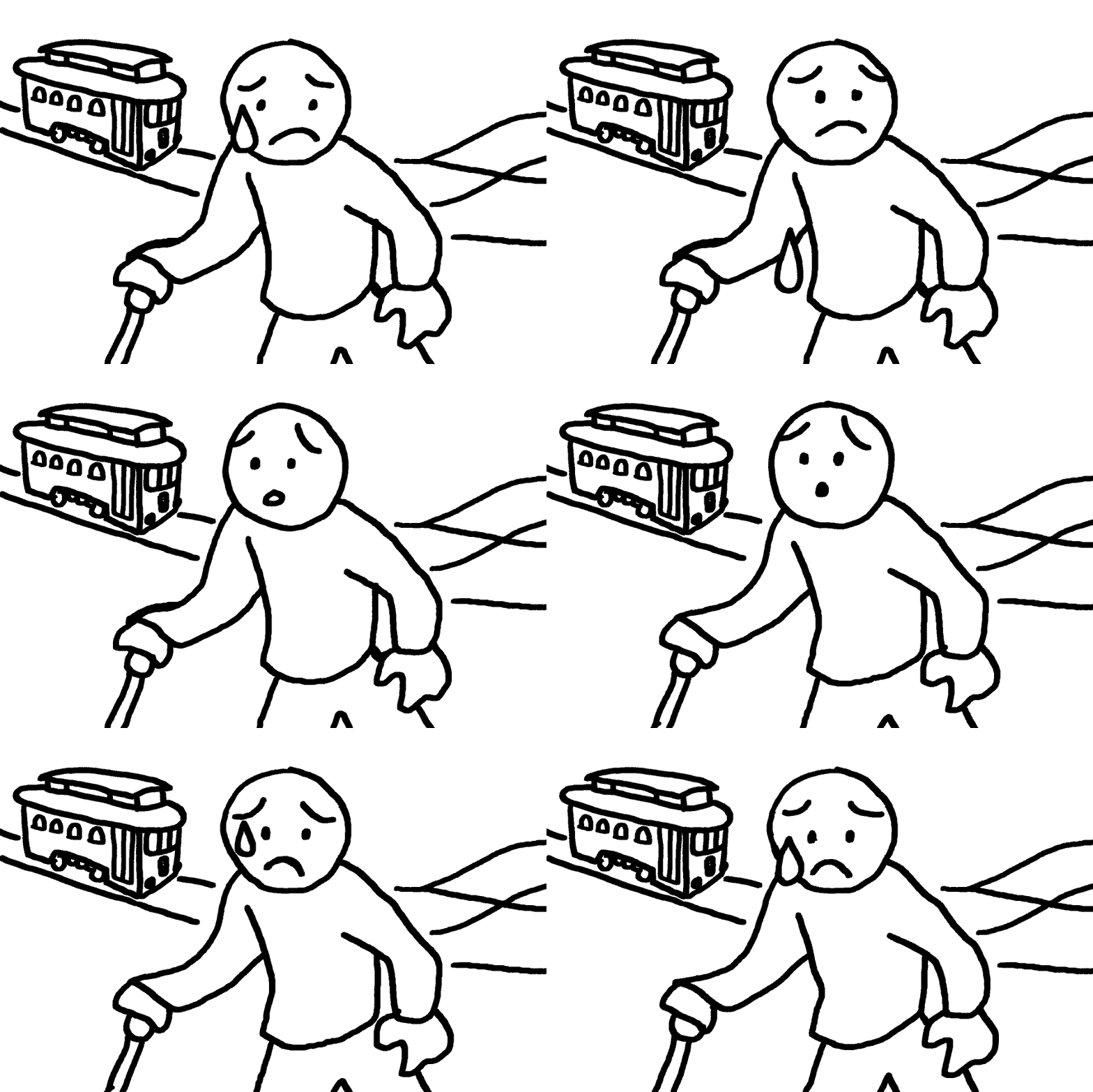
Picture show the following state of affairs: You lot are taking a freshman-level philosophy course in higher, and your professor has but asked y'all to imagine a runaway trolley barreling downwardly a track toward a group of 5 people. The just manner to save them from being killed, the professor says, is to hit a switch that will turn the trolley onto an alternating set of tracks where it will kill i person instead of 5. Now you must determine: Would the mulling over of this dilemma enlighten you in any manner?
I ask because the trolley-problem thought experiment described to a higher place—and its standard culminating question, Would it be morally permissible for you to hit the switch?—has in recent years become a mainstay of research in a subfield of psychology. Scientists use versions of the kill-1-to-salvage-five hypothetical, reworded and reframed for added dash, equally a standard way to probe the workings of the moral mind. The corpus of "trolleyology" information they've produced hints that men are more likely than women to sacrifice a life for the sake of several others, for example, and that younger people are inclined to do the same. (Argh, millennials and their consequentialist moral paradigm!) Trolley-trouble studies too tell us people may exist more probable to favor the practiced of the many over the rights of the few when they're reading in a foreign language, smelling Parmesan cheese, listening to sound effects of people farting, watching clips from Saturday Night Live, or otherwise subject to a cavalcade of weird and subtle morality-bending factors in the lab.
For all this method's enduring popularity, few have bothered to examine how information technology might relate to real-life moral judgments. Would your answers to a gear up of trolley hypotheticals represent with what you'd practice if, say, a deadly railroad train were really coming down the tracks, and you lot really did have the means to change its course? In November 2016, though, Dries Bostyn, a graduate educatee in social psychology at the University of Ghent, ran what may take been the first-always real-life version of a trolley-problem written report in the lab. In identify of railroad tracks and man victims, he used an electroschock machine and a colony of mice—and the question was no longer hypothetical: Would students press a push to zap a living, breathing mouse, so as to spare five other living, breathing mice from feeling pain?
"I recollect about everyone inside this field has considered running this experiment in real life, but for some reason no one ever got around to it," Bostyn says. He published his ain results last month: People'due south thoughts about imaginary trolleys and other sacrificial hypotheticals did not predict their actions with the mice, he found.
It's a discomfiting result, and ane that seems—at least at first—to throw a bedrock into the path of this research. Scientists have been using a set of cheap-and-easy mental probes (Would you hit the railroad switch?) to capture moral judgment. But if the answers to those questions don't connect to real beliefs, so where, exactly, have these trolley problems taken united states of america?
Let's start with where the field originated. In its mod form, the railway thought experiment started in the philosophy of ethics with Philippa Foot: In 1967, she asked her readers to imagine the driver of a "runaway tram" who could steer away from five potential victims, killing one instead. Another ethicist, Judith Jarvis Thomson, followed up with a more than expansive set of hypotheticals, now presented to the reader in the 2d person, with two competing versions of the trolley story: In the switch narrative, the idea-experimenter must decide if he or she would intervene to send the trolley downwardly a different rails. (That'due south the version given at the top of this piece.) Thomson contrasted this to the footbridge scenario, in which you're instructed to imagine that you're standing on a walkway up above the trolley tracks where the five people will before long be struck and killed. There's a large stranger standing on the bridge beside y'all, and if you push him to his decease (a feat you have the concrete chapters to attain), the trolley will be derailed before it hits the others. Is it morally permissible to shove the big guy to his sure death?
By laying out these two scenarios side by side, philosophers aimed to uncrease two competing moral frameworks—one that focuses on promotion of the greatest good, and the other on following rules for avoiding impairment. The juxtaposition proved illuminating because most people's moral intuitions seem to flip when the harm becomes more personal: They say that it's OK to hit the switch but not to shove the person off the bridge, even though the trade-off in human lives remains the same. Ethicists used this flip, and other intuitions drawn from trolley problems, in their arguments over how a person ought to brand a moral judgment in real life.
What had started out as rhetoric for philosophical debate ended up as fodder for experiments. In the early 2000s, a Princeton graduate student named Joshua Greene placed people in an fMRI brain scanner and confronted them with switch- and footbridge-blazon moral dilemmas, to come across how moral thinking played out in the brain. On the basis of this and other studies, he and his colleagues argued that the two varieties of moral reasoning arise from unlike anatomical structures. Greene proposed that a deadening, rational decision-making procedure leads people to arrive at a greatest-good determination (and say they'd flip the switch); while a quicker emotion-based process leads them to avoid inflicting impairment on principle (and say they'd never push the person off the bridge).
Greene's first paper on this topic has since been cited several thousand times. With that, new laboratory model had been established, and trolley problems came to serve as a means for borer split circuits in the brain, or at least separate means of thinking. Follow-upwardly inquiry leveraged people's responses to hypothetical dilemmas, especially trolley problems and their derivatives, to understand the nature of their mental processes, and how their moral judgments might exist formed or influenced. "People sometimes enquire me why I carp with these baroque hypothetical dilemmas," Greene wrote in 2009, by which time he'd joined the psychology faculty at Harvard. "To me, these dilemmas are like a geneticist's fruit flies. They're manageable enough to play around with in the lab but complex enough to capture something interesting about the wider and wilder world exterior."
But even from the starting time, people worried that these dilemmas might non fly outside the lab. "Fifty-fifty philosophers had complained about philosophers thinking also much almost trolley cases," said Greene in a recent interview. For ane matter, the imaginary setups were on their face absurd. (Why can't you just yell at the people to get off the tracks? How do we know this fat guy'due south torso will be enough to end the trolley? Does anyone still ride trolleys, anyhow? Et cetera.) It also seemed a lilliputian off that trolley problems were oftentimes posed in funny, entertaining means, while real-life moral dilemmas are unfunny as a rule. And information technology wasn't articulate how they related to reality. Fruit flies succeeded equally model organisms in part because they offered an cheap, flexible, and reproducible means of running experiments and gathering information. While the same could exist said of trolley trouble, these features merely make them halfway useful in the lab. Fruit-fly researchers know that more than half the insects' genes have homo analogues; to borrow Greene'due south phrase, it'south clear that fruit-wing biology "captures something interesting about the wider and wilder globe outside" the lab. Tin can the aforementioned be said of trolley-switch dilemmas?
That's what Bostyn was attempting to suss out in Kingdom of belgium. At starting time he idea of using existent-life people as potential victims in a Milgram-esque dilemma: Would you allow these five people receive electric shocks, or printing a switch to zap another guy instead? Only Bostyn figured the subjects in his study would realize that, rules-based ideals procedures being what they are, everyone involved had given their consent, and that agreement would brand the stakes as well low. So he went with animals instead. "Everyone always asks why we didn't utilise puppies or kittens instead of mice," he said. Afterward all, lots of people kill mice at home in the absence of a moral meltdown. Puppies or kittens would've been far more expensive, though. Lab mice are ubiquitous at research universities, and serve equally the default animals for many kinds of research.(You might say that they're like the trolley-issues of biomedicine.) For practical reasons, and so, Bostyn ended up using 1 well-established laboratory model to investigate another.
He worked as chop-chop as he could, so rumors wouldn't spread about the research he was doing. In the end, he brought several hundred people to the lab in one calendar week. Each experiment began with ten trolleyology dilemmas, including the classic story of the stranger on the footbridge. And then some participants were asked to consider ane more hypothetical: "Imagine the following state of affairs," this one read,
Yous are participating in an experiment as office of a course in Social Psychology. Previously, yous were asked to respond to several moral dilemmas, much like the ones you have answered. You are guided to the lab, the door opens and you encounter two cages with mice: 1 cage containing a unmarried mouse, 1 muzzle containing five mice. An electroshock is hooked up to both cages. The experimenter tells you that afterward a 20 second timer, an electric shock will be administered to the muzzle with the 5 mice only that you lot tin can push a button to redirect this daze to the cage containing the single mouse. The shocks are very painful but nonlethal. Would you press the push button?
Two-thirds of Bostyn's subjects said yes, they would indeed printing the button in this scenario.
The balance were tested on the real-life version of the mouse dilemma. In the lab were two cages with red plastic lids and mice within, an electroshock machine, and a laptop that showed the 20-second timer. When the timer got to zip, the experiment was over. No shocks were always administered to the animals, only the laptop recorded whether (and when) each participant had pressed the push. Participants would run into, in the stop, that the button had no effect—but at that point they'd already made their choice.
Almost 5-sixths of these subjects pressed the actual button, suggesting they were more inclined to make that choice in existent life than their fellow subjects were in hypotheticals. Moreover, people'southward responses to the 10 trolleyology dilemmas they were given at the start of the experiment—whether they imagined that they'd button the fat man off the bridge and all that—did not meaningfully predict their choices with live mice. Those who had seemed to be more focused on the greater good in the hypotheticals did seem to press the real-life push more quickly, though, and they described themselves equally existence more comfortable with their decision subsequently.
At least ane of Bostyn's findings—that when presented with a more realistic scenario, people are more than inclined to sacrifice an individual for the benefit of the grouping—falls in line with earlier inquiry. In the fall of 2016, merely before he ran his experiment, a team of psychologists at the University of Plymouth led past Kathryn Francis published a trolley written report that compared people's responses to text-based hypotheticals with their behaviors in a virtual-reality environment. Subjects either made their judgments on the written version of the footbridge scenario, or else they watched the same vignette unfold in an Oculus Rift headset. At ane point in the VR version, subjects heard a voice: Hey I am too far away but if y'all desire to relieve the people y'all could push the large person on to the tracks and particular the railroad train, information technology said. If you're going to push him, practice it now, but it is your selection. The sample size was minor, but Francis and her colleagues establish that people were more likely to push button the simulated stranger off the footbridge with a picture of a joystick than they were to say they'd push a stranger in the thought experiment.
And so in both the mouse written report and the VR experiment, more life-similar settings seemed to make subjects more businesslike in their moral judgments. Bostyn wonders if people who are presented with standard trolley hypotheticals requite biased answers considering they're worried near their reputations. They might remember that if they told the experimenter they'd flip the switch or push the stranger off the bridge, it would make them seem common cold and computing. To avoid that outcome, they tilt their responses in the contrary direction. But when they're confronted with a existent-life version of the same dilemma, and one with real-life stakes, they might ignore that social anxiety and enact their truer, more utilitarian moral judgment.
If people's answers to a trolley-type dilemma don't lucifer up exactly with their behaviors in a real-life (or realistic) version of the same, does that mean trolleyology itself has been derailed? The answer to that question depends on how you understood the purpose of those hypotheticals to begin with. Sure, they might not predict existent-earth deportment. Simply perhaps they're however useful for understanding existent-world redeportment. Later all, the laboratory game mirrors a mutual experience: one in which we hear or read about a thing that someone did—a policy that she enacted, perhaps, or a criminal offense that she committed—and then decide whether her behavior was ethical. If trolley issues tin can illuminate the mental process behind reading a narrative then making a moral judgment and so maybe we shouldn't care so much about what happened when this guy in Belgium pretended to be electrocuting mice.
Or perhaps the trolley problems don't fifty-fifty have to model any real-life situations whatsoever. They could provide insight into how people approximate the way they ought to act, or the way they'd like to deed, even if they would or could non act that style in practice.
"I don't deny the straightforward implications of [Bostyn'south] enquiry," says Greene. "You can't just ask people a hypothetical question, especially when it involves unfamiliar situations and relatively loftier stakes, and assume that what they say in response is what they would actually do. That'due south important and worth knowing." At the same fourth dimension, he says, Bostyn's data aren't grounds for saying that responses to trolley hypotheticals are useless or inane. After all, the mouse study did find that people'south answers to the hypotheticals predicted their actual levels of discomfort. Fifty-fifty if someone's feeling of discomfort may not ever translate to real-world beliefs, that doesn't hateful that it's irrelevant to moral judgment. "The more than sensible conclusion," Greene added over email, "is that we are looking at several weakly continued dots in a complex chain with multiple factors at work."
If that'southward the instance, so trolley hypotheticals could be a useful way of teasing out or fifty-fifty amplifying aspects of cognition that are hard to come across in real-life settings. Indeed, Greene insists that the dilemmas were never meant to serve equally "cheap surrogates" for how people would respond to actual conundrums: "That was never the goal from my point of view." Rather, the dilemmas were more similar highly tailored bogus stimuli. He compares them to the flashing checkerboards used by vision scientists to drive neural responses in the retina and cerebral cortex. We may not see a lot of flashing checkerboards in daily life, merely these stimuli can still activate the brain in reliable and telling means. The same goes for trolley problems, Greene argues: Even if they plough out to accept little bearing on reality, they can however exist useful as a tool of bones scientific discipline.
Bostyn's mice bated, there are other reasons to wary of the trolley hypotheticals. For one thing, a recent international project to reproduce forty major studies in the field of experimental philosophy included stabs at two of Greene's highly cited trolley-problem studies. Both failed to replicate. Then there's the fact that trolley-type dilemmas are oft interpreted as though they were a valid measure of a person's or a population'due south tendency toward utilitarian controlling. (That's how researchers concluded that men are more utilitarian than women and that millennials are more utilitarian than Gen-Xers.) But recent inquiry finds these hypotheticals only measure one component of commonsensical moral judgment; namely, the willingness to inflict sacrificial harm. That leaves out some other basic element of this upstanding framework: one'southward delivery to the greater adept, and positive investment in the well-being of strangers. That explains the awkward fact that trolley studies tend to label psychopaths every bit utilitarians despite their moral shortcomings. (Psychopaths, it turns out, tend to be quite willing to endorse pushing strangers off of footbridges.)
In the end, the value of the trolley problem equally a research tool may not depend on whether people take the same response in real-world situations. But given its ubiquity—and its well-established imperfections—it would take been a happier hypothetical for trolleyologists if Bostyn's study had come up out the other style.
Source: https://slate.com/technology/2018/06/psychologys-trolley-problem-might-have-a-problem.html

Post a Comment for "what is the answer to the trolley problem"